



Our remote video interpreting service
QbD Research and Development
Thanks for your support for the event. We have got excellent support from the interpreter and we thank you for your excellent support.

AUTO1 Group
Thank you for your support. The meeting went very well and those who used the interpretation were satisfied.

Accorinvest
The first feedbacks that I have received, they were very good and I would like to thank you for that !

Université de Sherbrooke
I wanted to thank you […] for the excellence of your services. Our event was a success.

Avril
I wanted to thank you for the work you did yesterday; all the attendees at the seminar appreciated your services.

Naturland
Thank you for the quality of the interpretation. Thank you for your work
8 Essential Reasons To Use a Video Interpreting Service
"Chat with the whole world in your language... without leaving the room. "
- Grow your business abroad without hiring added multilingual staff
- Accurately convey your strategic message – no matter what your audience’s language
- Significantly reduce your travel costs abroad
- Improve the confidence of your interviews without missing any quality " face-to-face" time
- Meet live to discuss projects and share your applications worldwide without traveling
- Forget any worries about needing to speak any foreign languages for business
- Open a global audience to your webinars, conferences, and events
- Connect your physical meeting rooms with virtual meeting rooms
Atenao & Zoom: A Winning Duo!
Atenao's translation and interpretation service is 100% compatible with the most popular videoconferencing solutions. Our interpreters can “piggyback” onto most business videoconferencing systems, but since few of these systems are truly “Interpreting-compatible,” we recommend our clients organize their events, meetings and webinars in one of our own virtual meeting rooms.
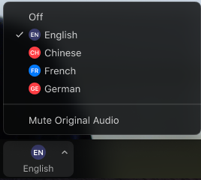
In most cases, whether it’s in Microsoft Teams or Google Meet for example, the absence of a specific sound channel dedicated to interpreters prevents the use of simultaneous interpretation.
Only a link interpretation is possible here, with the drawbacks inherent in this type of interpretation. These include forced pauses after each sentence to allow the interpreter to translate, inhibiting the translation language fluency, and limiting the ability to work in several added linguistic translation combinations…
After testing and reviewing many videoconferencing solutions, Atenao has chosen to work with Zoom, the only one to make simultaneous interpretation possible via dedicated sound channels for each linguistic translation pair.
The advantages offered by Zoom to connect a physical meeting room to a virtual meeting room, to segment a virtual meeting into sub-groups (for hosting workshops, for example), to easily create webinars, and the ability to record meeting presentations and discussions - plus transcribe them - are all benefits that asserted Zoom as our top videoconferencing choice here.
The Face-To-Face Video Interview
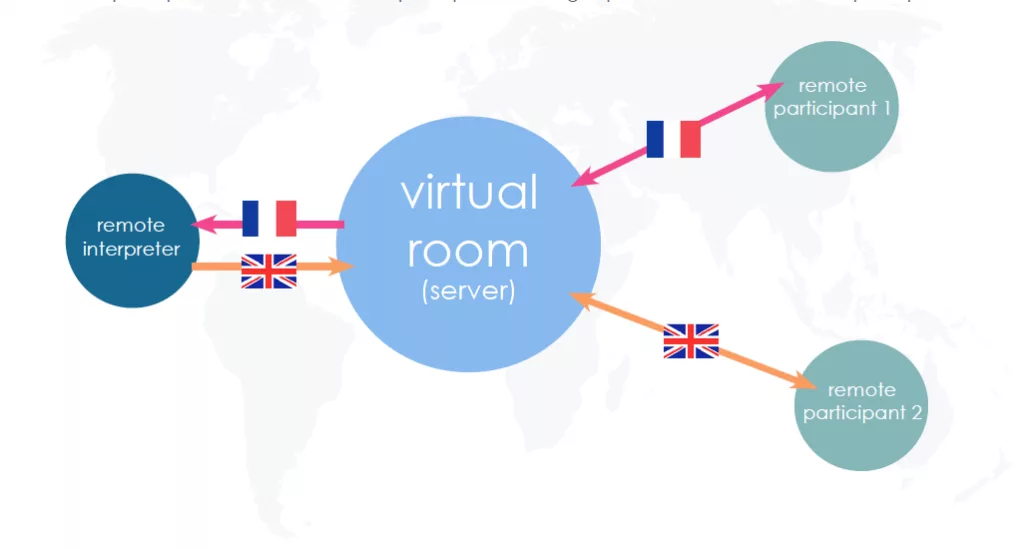
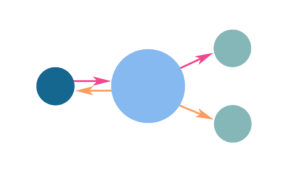
Meeting face-to-face is the most common interview type. It connects two people at a distance who don’t speak the same language.
During the meeting, each attendee speaks in their own language. From Atenaos' video interpreting services, one of our interpreters, fluent in both languages, orally and simultaneously translates the words of each speaker into the language of the other.
Each speaker hears the words translated by the interpreter into their own language, with the voice of the original speaker in the background.

In a face-to-face interview the number of participants is not limited, but the number of languages is. It can only support a maximum of two languages per meeting, or basically just one single linguistic combination.
A face-to-face interview can also conveniently connect :
- A participant and a group of participants
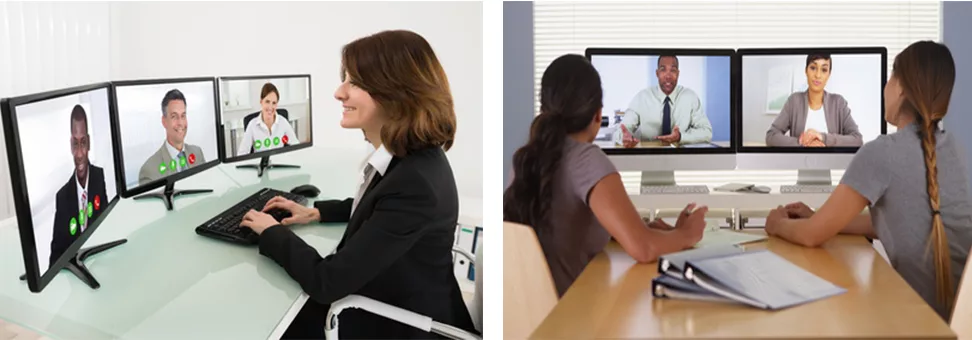
- A participant and a group of participants in a physical meeting room equipped with a screen
- Two groups of participants, each working from two remote meeting rooms equipped with a screen in each.
Just like in a bilingual face-to-face interview between two people, Atenao provides video interpreting services where the interpreter translates, from a distance, the words of each participant in both languages.

The Remote Conference Meeting
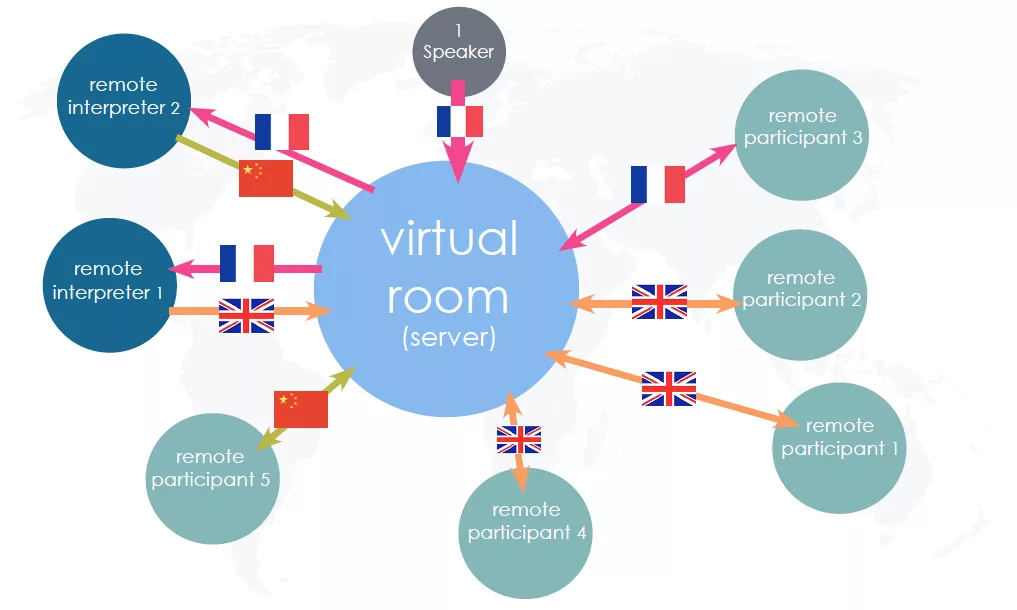
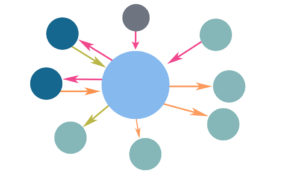
Bilingual or multilingual, this type of meeting is the most complex type of remote videoconferencing – but without losing any language fluency or fidelity.
Each meeting participant can hear the main speaker’s voice in a softly audible tone while clearly hearing the voice of their interpreter at a higher sound level, for a smooth and understandable effect nearly identical to a professional voice-over.
The Videoconference Meeting Host
Seldom needed for face-to-face meetings, the meeting host or facilitator takes on an important and even essential role in videoconference meetings and group conferences. These videoconferences can gather up to 300 participants and around 20 interpreters. The facilitator handles many aspects of the meeting, such as:
• Managing the participants
• Controlling the audio and video settings
• Inviting others to join the meeting
• Controlling screen sharing
• Recording the discussions and presentations
• Segmenting the virtual room into smaller groups
• Ending the meeting
To facilitate the most organized videoconferencing meetings possible, Atenao provides meeting hosts who can master the Zoom videoconferencing parameters to our clients’ wishes. For customers preferring to host and manage their own Zoom videoconference for confidentiality or cost effectiveness reasons, this is easily delegated back over to them.
The Video Webinar
Just like with the one-on-one and combined conference meetings, a specific sound channel is dedicated to each translated linguistic combination. Each audience member, participant, or speaker simply needs to connect with their specific translation sound channel for their own language.
No more costly interpreter travel, bulky and fully equipped double-interpretation booths, or room and board expense… Videoconference interpretation, together with webinar applications, democratize international conferences for an optimal cost within reach to all organizations, no matter what their company size and structure.
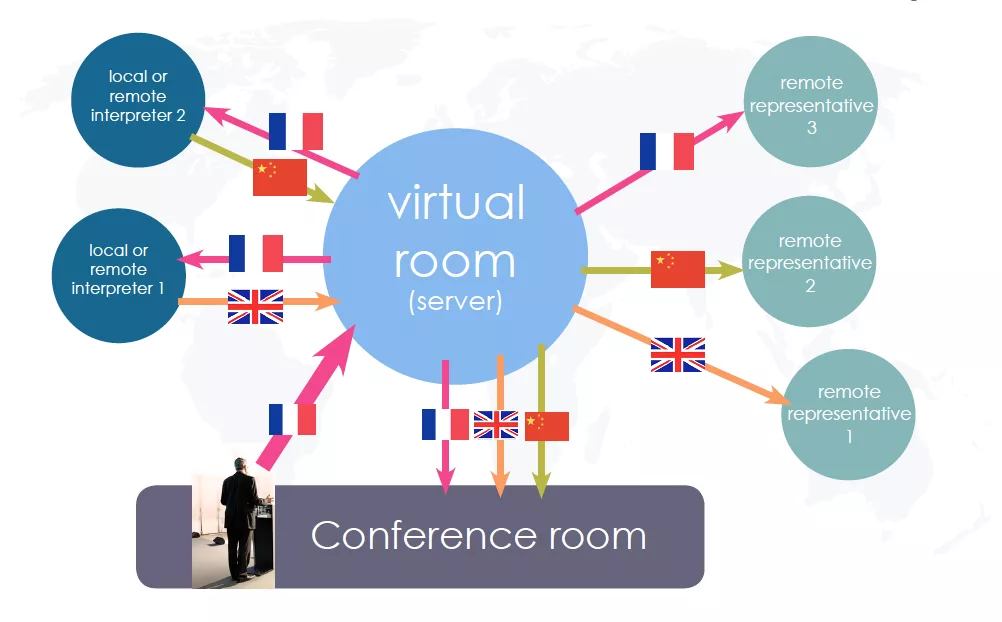
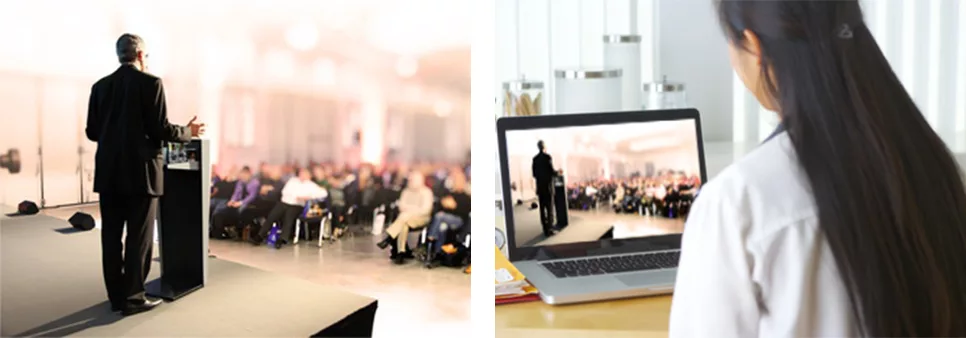
Face-to-face
|
Meeting / Conference
|
Webinar
|
|
| Participants | 2 | up to 300 | up to 100 and 10,000 muted participants |
| Languages | 2 |
all official languages |
all official languages |
| Language pairs | 1 |
all language combinations |
all language combinations |
| Interpreters | 1 per language pair for up to 1.5 hours 2 per language pair for longer than 1.5 hours |
||
| Duration | No limit | ||
| Security | Password access, attendee controls, ability to lock the room | ||
| Chat | public or private | ||
| Screen sharing | Yes | ||
| Recording | audio, video | ||
| Subtitles | transcription, adaptation, audio mixing on quotation | ||
| Apparatus | Computer, laptop, tablet, smartphone with webcam, headset | ||
| Operating system | Windows, MacOS, Android, iOS | ||
| Sign in | ADSL / Fiber (wired or Wi-Fi), 4G or 5G Minimum requirements: 2 Mbps download / 2 Mbps upload Recommended: 10 Mbps download / 4 Mbps upload and higher Ping value bellow 50, jitter bellow 15. Use speedtest link to measure bandwidth and latency |
||
Contact us today to schedule a live translation interpretation for your next videoconference meeting.
FAQ
Most remote interpreting platforms work in much the same way. To illustrate the process, let's take Zoom, the platform chosen by Atenao, as an example.
Today, remote interpreting is used almost exclusively for simultaneous interpreting. Leading video conferencing platforms are designed to let participants follow discussions in their own language, in real time, without interrupting the flow of the meeting.
Consecutive interpreting via video conference is technically possible, but in practice it offers very few advantages:
- it almost doubles the length of the meeting;
- it is more tiring for participants;
- it disrupts the natural flow of the discussion.
Remote interpreting is still rarely used for liaison interpreting or guided tours. However, it is an extremely effective solution whenever participants do not need to see one another.
The process is straightforward: the guide, trainer or presenter joins a Zoom meeting (or a similar platform) using a smartphone; the interpreter joins the same meeting and interprets in real time; participants follow the tour or presentation while listening to the interpretation directly on their smartphones using earphones or a headset.
Provided there is a reliable internet connection, this approach offers a simple, cost-effective and highly efficient alternative to traditional guided tour systems.
Most major video conferencing platforms now include multilingual interpretation features. The most widely used include Zoom, Microsoft Teams, Cisco Webex, and dedicated interpreting platforms such as KUDO, Interprefy and VoiceBoxer.
The right platform depends mainly on how often you need interpreting, the type of events you organise, the number of participants and the number of languages involved.
For recurring requirements, international conferences or complex multilingual events, platforms such as Zoom, Cisco Webex, KUDO and Interprefy provide greater flexibility for managing languages, interpreters and participants. They are particularly well suited to webinars, conferences and hybrid events involving large numbers of speakers, while remaining equally effective for smaller-scale assignments.
For straightforward meetings with a limited number of participants and one or two interpretation languages, Microsoft Teams can be an excellent choice, especially for organisations already using Microsoft 365. However, at the time of writing, Teams does not support bidirectional interpretation channels. As a result, it is not suitable for meetings where interpretation is required in both directions of the same language pair.
The cost of remote interpreting depends on two main factors: the technical platform used and the interpreters' fees.
Most platforms offer a range of subscription plans, with pricing depending on the available features, such as simultaneous interpretation, webinars, participant capacity and technical support. For example, a Zoom Professional subscription allowing unlimited meetings costs around €200 (excl. VAT) per user per year, whereas AI-assisted interpreting platforms such as Wordly offer plans starting at over €2,000 per year.
For one-off events, it is often more cost-effective to let a professional interpreting agency organise the meeting. The agency already holds the necessary licences and will choose the most suitable platform for your event, eliminating the need for you to purchase a subscription. Beyond cost savings, you also benefit from technical support, pre-event testing, platform setup and interpreter coordination on the day of the event.
The cost of professional interpreters
Interpreter fees mainly depend on the language combination and the duration of the assignment. For meetings lasting up to around 90 minutes, a single interpreter can usually handle the session with one or two short breaks. For the most common language pairs, you should budget approximately €450 (excl. VAT).
For simultaneous interpreting sessions lasting longer than 90 minutes, two interpreters are essential to ensure consistent quality. The budget should therefore be adjusted accordingly.